A rule connecting every element in a set D called the domain with exactly one element in a set E called the codomain. We know a graph is a function with the vertical line test in which the line intersects the graph once.
→ We test even and odd functions either with the graph (symmetric about y-axis and symmetric about origin) or ($f(-x)=f(x)$ and $f(-x)=-f(x)$)
Function Transformations:
<aside> 💡 Order:
</aside>
$$ y=\pm Af(\pm B(x+C))+D $$
$\space \space \space Scaling \Rightarrow Reflection \Rightarrow Shifting \newline \space \space \space \space \space \space \space \space \space \space \space \space \space \space \space \space \space \space (inner) \Rightarrow (outer)$
→ coefficient of $x$ should be 1 value and sign
$\lim_{x\to a^+} f(x)=L$ means as x approaches (not equal) a from the right, the values of f(x) approach L.
$\lim_{x\to a^-} f(x)=L$ means as x approaches (not equal) a from the left, the values of f(x) approach L.
Function is continuous if and only if $f(a)=\lim_{x\to a^+} f(x)=\lim_{x\to a^-} f(x)=L$
$\lim_{x\to a^+} f(x)=\lim_{x\to a^-} f(x)=L$
then the limit exists.
If $f(x)$ is a continuous function then
$\lim_{x\to a} f(g(x)) = f(\lim_{x\to a} g(x))$
If $\lim= \frac{number\ne 0}{0}$ the answer is either $-\infty$ or $\infty$ and we know the answer by taking a number greater and smaller than what variable approaches.
Def: A line $x=a$ is called a vertical asymptote (finite to get infinite) if $\lim_{x\to a^+} f(x) =\pm \infty$ or $\lim_{x\to a^-} f(x) =\pm \infty$
Def: A line $y=b$ is called a horizontal asymptote (infinite to get finite) if $\lim_{x\to \infty} f(x) = b$ or $\lim_{x\to -\infty} f(x) =b$
$f(x)$ could have any number of V.A.s but at most two H.A.s
7 indeterminate forms: $\frac{0}{0},\space \frac{\pm \infty}{\pm \infty},\space 0.\pm \infty,\space \infty-\infty,\space 1^\infty,\space 0^0,\space \infty^0$
If $\lim_{x\to a}\frac{f(x)}{g(x)} = \frac{0}{0}$ or $\frac{\pm\infty}{\pm\infty}$ then $\lim_{x\to a}\frac{f(x)}{g(x)} = \lim_{x\to a} \frac{f'(x)}{g'(x)}$
If $\lim_{x\to a}{f(x)} = \infty - \infty$ then multiply with conjugate, use function properties or common denominator
If $\lim_{x\to a}{f(x)} = 0. \pm \infty$ then we create a denominator to make it (1) $\lim_{x\to a}{f(x)}{g(x)}, f(x)\to 0, g(x) \to \infty$
$\frac{1}{f(x)} \to \infty , \frac{1}{g(x)} \to 0$
$\lim_{x\to a^-} f(x) =L$ means as x approaches (not equal) a from the left
If $\lim_{x \to \infty} f(x) = 1^\infty$ or $0^0$ or $\infty^0$ we get rid of the power with properties of logarithms $y=f(x) \Rightarrow \ln y = \ln f(x)$ so we find $\lim_{x \to \infty} \ln y = b$ and thus $\lim_{x\to \infty} y= \lim_{x\to \infty} f(x) = e^b$
$\lim_{x \to \infty}(1+\frac{a}{x})^{bx}= \lim_{x \to 0}(1+ax)^{\frac{b}{x}}= e^{ab}$
Implicit differentiation:
we differentiate both sides of an equation separately such that we treat one of the variables as a function of the other.
Higher order derivatives:
$\frac{d^n}{dx^n} f(x) = f^{(n)}(x)$ is the nth-derivative.
→ f(x) is not differentiable at corners, cusps and discontinuity points (jumps and endpoints)
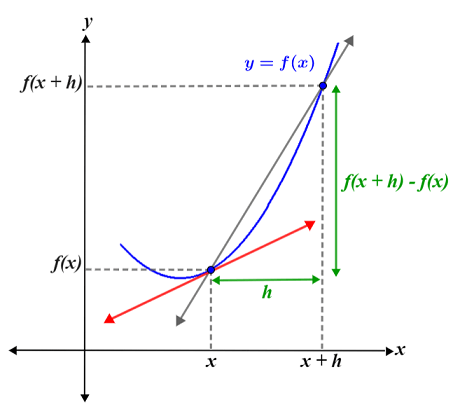
The slope of the tangent line is $\lim_{h\to 0} \frac{f(x+h)-f(x)}{h} \space = \space f'(x)$ ; x being the x-value at which the tangent hits the curve
The slope of the normal to the tangent line is $\frac{-1}{f'(x)}$
Chain Rule:
$\frac{d}{dx} f(g(x)) = g'(x)f'(g(x))$
Inverse Differentiation:
$\frac{d}{dx} f^{-1}(x) = \frac{1}{f'(f^{-1}(x))}$
we have two main methods, either find the inverse and its derivative or set $f^{-1}(a)=x \rightarrow a=f(x)$ then find x.
Logarithmic Differentiation:
used if we have a variable power or a complex function
$\frac{d}{dx} \ln g(x) = \frac{g'(x)}{g(x)}$
One-sided derivatives and Continuity:
If f(x) is differentiable at x=a (f’(a) exits) then f(x) is continuous at x=a
$f_+'(a)=f_-'(a) \Rightarrow \lim_{x\to a^+} \frac{f(x)-f(a)}{x-a} =\lim_{x\to a^-} \frac{f(x)-f(a)}{x-a}$
Finding limits with the definition of derivative:
$f'(a)=\lim_{x\to a}\frac{f(x)-f(a)}{x-a}$ from which we extract the function